
Abolishing Property Taxes Doesn't Solve Any Problems
Limiting property taxes limits local control and encourages localities to rig the system. It's irresponsible to talk about eliminating property tax without providing an alternative revenue source.

The Future Of Where can’t survive without your support. Please become a free or paid subscriber today. Although Substack defaults to the paid option when you click, it’s easy to choose the free option if you prefer.
On Tuesday, Aaron Renn – the rare conservative who writes positively about cities and communities – published a piece in The New York Times provocatively titled, “The G.O.P. War on Property Taxes Will Lose Them The Suburbs”. Aaron devoted the piece to demolishing the Republican argument (pushed especially by Govs. Ron DeSantis of Florida and Greg Abbott of Texas) that property tax is somehow thievery because people have to pay it every year and therefore they don’t really own their house.
The truth is that most suburban voters who lean Republican can come up with the cash. And, as Aaron pointed out in his Times piece, they actually expect their community to provide the high-amenity things property taxes typically buy: police and fire protection, good schools, parks and playgrounds, libraries, and so forth.
But all these things cost money. So if you take away the property tax without figuring out an alternative source of revenue, you’re likely setting up a community for chaos. Or more control from the state capitol.
You can just imagine this happening in Texas, which is one of the highest property-tax states in the nation. Texas has already passed a limitation on property tax and is now, as I mentioned above, rumbling with the idea of eliminating them altogether. But Texas communities – and the state itself – are extremely dependent on property tax revenue. Income tax is prohibited by the state constitution and sales tax – the other major source of revenue for incorporated cities – is not especially high and hard for local communities to increase.
Texas Is Extremely Dependent on Property Taxes
Already, the state government in Austin shifts local property taxes around from some school districts to others to even things out – especially to transfer property taxes from urban school districts (which typically have a big property tax base but also many needy students) to poor rural school districts (which are often shrinking and have few sources of revenue).
But if you eliminated property taxes altogether, even this sleight of hand would go away. With no property taxes at all, Austin would have to come up with some new and unidentified source of revenue. In particular, the state would be expected to figure out how to fund K-12 education (whether the money is spent on schools or vouchers). Most likely, if the experience in other states is any guide, Austin would seek control that revenue too, meaning local communities would not be able to control how their own communities are funded.
Or all the cities and counties in Texas will engage in crazy maneuvering with all kinds of bad side effects in order to hold things together.
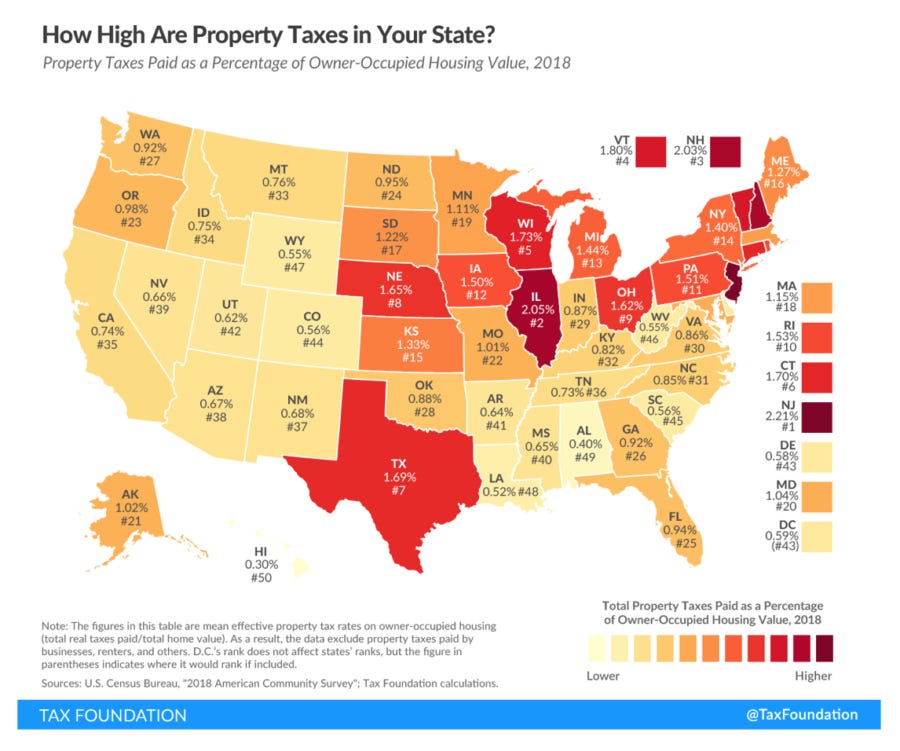
Texas has the highest property taxes of any state in the Sunbelt.
Which is what has happened in California under Proposition 13.
Passed in 1978, Prop. 13 is the granddaddy of all property tax limitations and also the most severe. Prop. 13 limits the overall property tax rate to 1% of assessed value (in Texas it’s around 2.5%) and also basically prohibits increases in assessment while you own your property – full reassessment only occurs when you sell your property.
Intentionally or not, Prop. 13 also took a lot of power away from local governments and concentrated it in Sacramento, where the state government decides how that 1% is divided between cities, counties, school districts, and other local agencies. To be clear: These local agencies have no control over how much property tax revenue they get. The state decides.
What California’s Proposition 13 Did
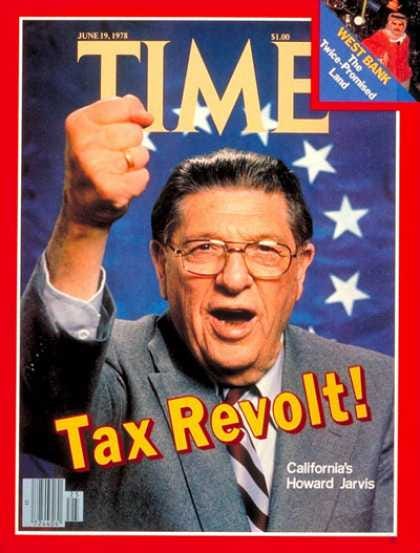
The stated intent of Prop. 13 was to protect people of limited income such as retirees from rising property taxes during a time of rapidly rising home prices. In truth it was promoted by the Apartment Association of Greater Los Angeles, whose members benefited mightily from it. (Curiously, Prop. 13 champion Howard Jarvis’s Wikipedia page makes no mention of the Apartment Association, which he worked for.) Yes, retirees saved money. But so did owners of big apartment buildings and shopping centers, so long as they didn’t sell their property.
After Proposition 13 passed, the assumption was that with less revenue, local government in California would shrink.
But that’s not what happened. What happened was cities and counties got much more clever and ruthless about raising money and more dependent on the state government.
Among other things:
— School districts became far more dependent on funds from Sacramento, generated mostly by state income taxes, with the result that the California Teachers Association is now the most powerful lobbying group in the state.
— Cities and counties began to shift the cost of public infrastructure and amenities (roads, libraries, parks, new school buildings) from all taxpayers to new residents through a variety of mechanisms, including special taxing districts and (especially) high impact fees, which have had the effect of
