
Geographical Names Matter: How To Connect People More Strongly To The Region Where They Live
For more than a century, the Census Bureau has named metropolitan areas after their central cities. But using a name that depicts the whole region instad invites people to belong.

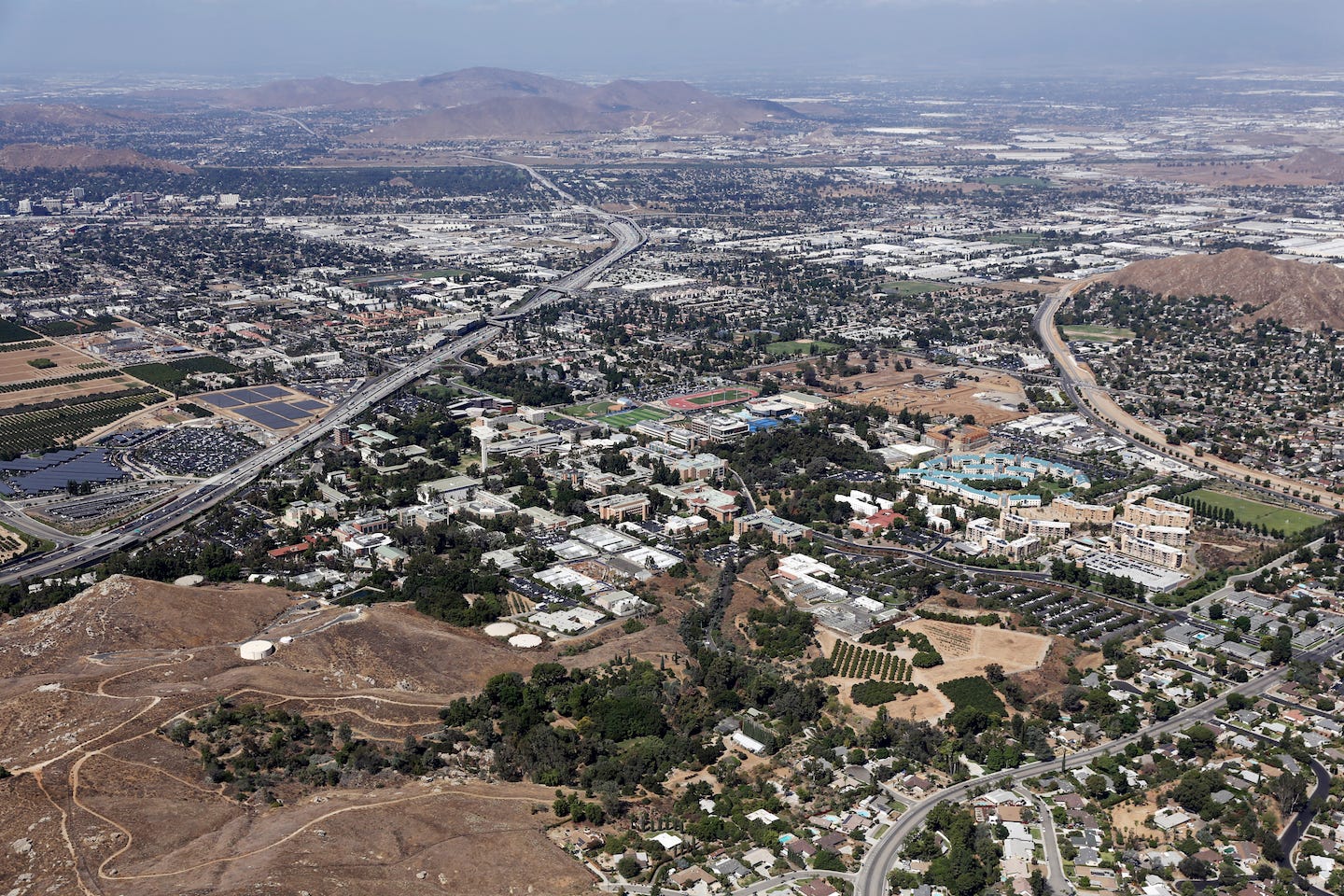
With 5 million people, California’s Inland Empire is both a separat metropolitan area according to the Census and still a suburb of Los Angeles.
Become a free or paid subscriber to The Future Of Where today! And Founding Members get a free autographed copy of Bill Fulton’s book Place And Prosperity!
In my recent call to have readers “Ask Me Anything,” David Baab – a longtime urban designer in Irvine – challenged me to think about metro areas and suburbs in a different way.
He did so by asking two questions:
1. Why do we name our metro areas after the central city?
2. How come we call any city outside the central city as a “suburb”
What David is really calling for is a complete rethinking of the geographical nomenclature of our metropolitan areas. (That was three long words, sorry.) And maybe we’re past time for a rethinking.
After all, the federal government first created our modern definition of “metropolitan areas” in 1949 and hasn’t really updated that definition since 1983 (though more and more counties are being added to our ever-sprawling metropolises). The “micropolitan” areas – regions so small in population they cannot be considered “metropolitan” – were added in 2003.
And through all of this, the Census Bureau still used the central city as the basis for the nomenclature, just as it has done since it first began defining metropolitan areas in 1910.
We’ve had various attempts over the years at creating a new and more informal nomenclature for overgrown suburbs. Back in the early ‘90s, for example, journalist Joel Garreau came up with the term “Edge City,” which got a lot of publicity. But Garreau was describing a very particular type of suburban development: densely built job centers like Century City in Los Angeles, The Galleria in Houston, and Tysons Corners in Virginia (or suburban D.C., depending on how you name it). It wasn’t really an attempt to rethink the whole suburban landscape.
And as our metro areas have sprawled farther and farther afield, the Census Bureau has struggled to keep up. For example, in 2003 the Bureau finally gave Southern California’s Inland Empire separate metropolitan status (naming it the Riverside-San Bernardino-Ontario MSA, for three “central” cities ranging in population from 200,000 to 300,000).
There’s no question the Inland Empire is huge – at almost 5 million people, it has about the same population as Boston and it’s much larger than Seattle. But it’s hard to argue that it’s anything more than the world’s biggest suburb. The IE’s ratio of jobs to residents is by far the lowest of any big metro area in the country – about the same as the resort community of Hilton Head, S.C. (It’s worth noting that the Inland Empire is still part of the Los Angeles consolidated metropolitan statistical area as defined by the Census and also part of the L.A. regional planning agency, the Southern California Association of Governments. And there’s that phrase “Southern California” – more on that later.)
Renaming Our Suburbs and Region
But none of this quite captures what’s really going on. What we don’t have is two things:
First, a word that describes and unites the concept of human settlements. Community, ot quote.
And second, a word that accurately describes the modern archipelago of separate but interconnected communities that make up the typical American landscape.
I’m not sure I have a good answer for the first one. “Cities” is too limiting, since it has too many different meanings (a municipality as well as a place) and it turns small-town and rural folks off. My friend Henry Cisneros, the former Mayor of San Antonio and Clinton housing secretary, often used to use the phrase “cities and towns,” but this too can be confusing, because the term “town” can have many meanings. (In the United Kingdom, city planning is usually called “town planning,” and in the U.S. towns and townships are often subdivisions of counties, not specific human settlements.)
Help us out by sharing this post with anybody you think might be interested in it — and encouraging them to become a free or paid subscriber!
I often try to get around this problem by using the term “community,” which sort of gets at the idea of a human settlement that hangs together. But “community” is oftern overused in other contexts, since we tend to use is to describe communities of interest as well as geographical communities. (For example, “the development community,” “the gun community,” “the gay community”.)
So if we’re going to come up with a new name for a suburb that reflects the fact that it is more than a suburb, I’m not sure what it is. I’ve often thought of a suburb as a place where you have to drive everywhere, but that means Orange County in California is a suburb, which it’s clearly not. (It’s got a gross domestic product that’s about the same size as South Carolina.)
But on David Baab’s second question – why do we name metropolitan areas after central cities that people who live in the region may have never been to and may be trying to avoid – I think there’s a better answer, and one that has profound implications for the sense of belonging people might feel for their metropolitan region.
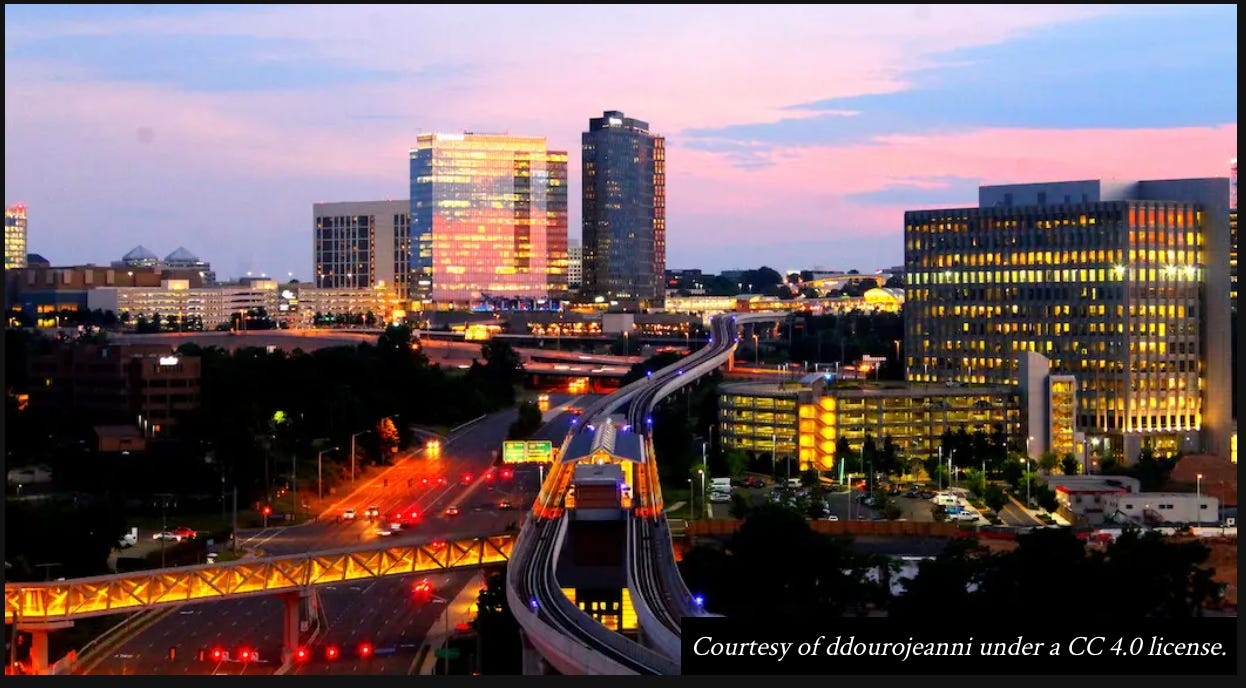
Tysons Corners is in “suburban” Virginia but it’s not really a suburb.
People in Orange County don’t want to be part of Los Angeles. People in central New Jersey probably won’t want to be part of New York. People in semi-rural Maryland don’t want to be part of D.C.
But they all can feel like they are part of a region if the region is not named for the central city.
And, increasingly, these regions – for local purposes – name themselves after the geographical location where they are located rather than the central city. So we have Southern California (originally a marketing term for Los Angeles), South Florida (for Miami/Broward/Palm Beach Counties), the Wasatch Fron (Salt Lake City), the Puget Sound region (Seattle), DMV (for D.C., Maryland, and Virginia), Central Texas (Austin), Northeast Ohio (Cleveland), and on and on and on.
Of course, this hasn’t happened everywhere. In the sprawling Atlanta region, the City of Atlanta has only about 8-10% of the metropolitan region’s population, but the term “Atlanta” seems ubiquitous Even the regional planning agency is called the Atlanta Regional Commission. (And it has published an interesting take of its own on the Atlanta region’s ever-changing boundaries.)
But You’re Still From Cleveland
This does not mean these terms travel well around the world or even around the country. If you’re in Tokyo, you’re not going to say you’re from Northeast Ohio. You’re going to say you’re from Cleveland, or at least Near Cleveland, or maybe Near Where Lebron James Grew Up.
Which is a point worth making for two reasons. First, because it’s still the names of the big cities that are the brand names worldwide. And second, because the origins of almost all of our metropolitan areas emanated from the original central city. There would be no Orange County or Inland Empire without Los Angeles.
Nevertheless, using Southern California instead of L.A. and South Florida instead of Miami has the effect of inviting people in to the idea that they belong to a region. You can hate the central city – living in what we will call, for want of a better term, a “suburban area” and deliberately never going to the central city – and still feel like a citizen of the region.
Yes, you can still feel like you have little in common with those poor schlubs who live back in the central city. You can define yourself mostly by separating you and your community from others. And yet you can still feel like you belong to something geographically larger than your neighborhood or your suburban city. And that’s a really good thing.
Check Out My Appears On The Talking Headways Podcast
I had fun talking with Jeff Wood on his well-known Talking Headways podcast. Jeff is one of the most astute observers of urban and suburban trends in the U.S. – he lives in San Francisco but grew up in suburban Houston – and we had a wide ranging conversation covering all kinds of topics, including migration trends in the U.S., California’s zoning reform, and lots of other things that I often talk about here at The Future Of Where. So check it out!
Bill, you know how we have struggled with this in Houston. “Texas Gulf Coast” sounded like we planned to annex Corpus Christi. “Southeast Texas” meant including the (once) Golden Triangle. “Houston-Galveston Area” sounded like an Archdiocese or a regional planning council. So “Greater Houston” or just plain “Houston” lingers on. Sorry Sugar Land.
A bit of a sidebar, but to your point: fans of the Angels baseball team absolutely abhor the official name for that club - “The Los Angeles Angels of Anaheim.”