
Have We Reached Peak Zoning?
On its 100th anniversary, the Euclid case may or may not be overturned. But the days of "nanny zoning" micromanaging what people can do with -- or even on -- their property may be numbered.

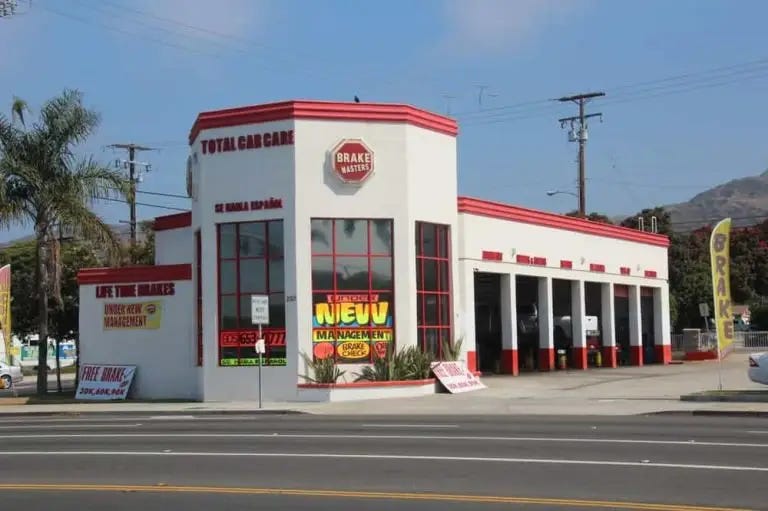
The brake shop with no horizontal red line.
The Future Of Where depends on you. Become a paid subscriber to help us pay the bills or a free subscriber to help expand our influence. If you become a Founding Member, you’ll get a free autographed copy of Bill Fulton’s book Place And Prosperity.
One day when I was Mayor of Ventura, I got an email from a constituent concerned about his neighbor’s macaws.
The macaws were loud, he said, and he asked us to do something about it. But he wanted to be reasonable. He had looked at Ventura’s zoning ordinance, which limited residents to having six birds on site. Six birds was reasonable for most species, he acknowledged, but macaws were different because they were so loud. He suggested changing the zoning ordinance to allow six birds generally but only two if they were macaws.
I don’t remember exactly how I responded, but I probably tried to find some gentle way to explain to him that, even if we made that change to the zoning ordinance, we had no way to enforce it. We had 2½ code enforcement officers for a city of more than 100,000 people. We couldn’t enforce the code against the guy who ran a gravel pit in his back yard. We couldn’t enforce the code against my next-door neighbor, a hoarder who had cars piled up in his driveway right outside my window.
We had a zoning code that tried to micromanage how people lived, and we couldn’t enforce it even if we wanted to.
This year marks 100 years since zoning was – surprisingly – declared constitutional by a very conservative U.S. Supreme Court (literally nine old white guys with beards) in the famous case from the Cleveland area known as Euclid v. Ambler. But there’s a major re-examination of zoning going on these days – it’s now blamed for a multitude of sins, not the least of which is the high cost of housing – and it makes me wonder whether the courts will pare back zoning in the future.
In other words, have we reached “peak zoning”. And, if so, what happens next?
“Pig In The Parlor” Or “Parasite”?
This question came to mind Friday as I participated in the first of what is likely to be many symposia and conferences dealing with the 100th anniversary of Euclid – this one held at the Antonin Scalia Law School at George Mason University in suburban D.C., co-sponsored by the pro-property rights Pacific Legal Foundation and the Mercatus Center at GMU. There was a lot of nerdy law-school talk about zoning – mostly from the property rights side – but there was also the big-picture question of whether zoning will survive at all, given the U.S. Supreme Court we have these days.
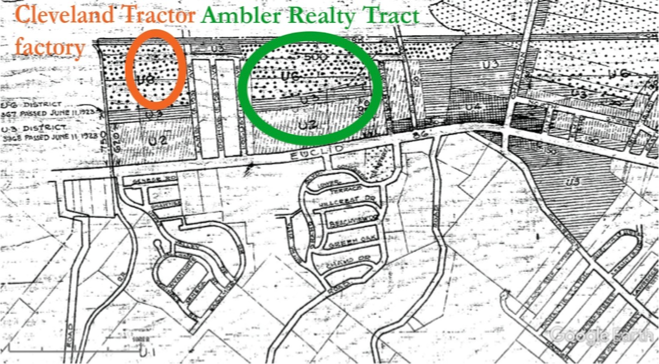
Ambler Realty claimed zoning deprived it of its Constitutional property rights.
There’ll be a lot of debate this year as to whether the original purpose of zoning was noble or nefarious. On the noble side, zoning tries to protect people from things that could harm them – the infamous “pig in a parlor” analogy that Justice George Sutherland used in Euclid. On the nefarious side, there’s been renewed discussion in recent years that zoning – and this is part of the reason it was upheld by nine old white guys with beards – was designed primarily to protect certain people from things that could harm them. In particular, affluent folks who lived in single-famous homes. Famously, Sutherland – apparently referring to the residences of both African-American and Eastern European residents who did not live in single-family homes – said that “the apartment house is a mere parasite, constructed in order to take advantage of the open spaces and attractive surroundings created by the residential character of the district.” As if apartment are not residences.
There’s little question that even many real estate developers favored zoning for this very reason, because it protected the investment of their single-family home buyers. And over the last hundred years we’ve seen a hundred different ways for single-family homeowners to box out everybody else, including minimum lots sizes, minimum house sizes, and even restrictions on unrelated individuals living in the same house.
In other words, we’ve come to tolerate a level of intrusion into our daily lives that none of us would tolerate if it didn’t involve regulating the built environment. The result, of course, is not enough housing, housing that’s too expensive, a limit on the number of birds, a ban on chickens, and – in general – a “nanny” approach to the built environment that has made everything more expensive and difficult than it should be.
Most of the discussion about zoning in the last couple of year has been focused on housing. But I think housing is simply the cause d’jour. The bigger issue is the expectation on the part of the current residents of a community that they can control absolutely every little thing about what other property owners do with their property.
The ‘50s Diner and the Brake Shop
I lived through this again and again in Ventura. There was, for example, the famous case of the ‘50s diner that wanted to put the letters “Air Conditioned” on its window, with chilly ice dripping off the letters. After an enormous fight, this was not permitted because the words “Air Conditioned” caused the lettering the exceed 25% of the window, which a violation of the code.
The diner without the Air Conditioned sign.
Then there was the battle over the red horizontal line on the Brakemasters building near my house. Brakemasters routinely puts a horizontal red line across the upper part of their building. But in Ventura – after the Planning Commission had approved the project and the building had been built – the red line was viewed by the neighborhood as so offensive that the city forced Brakemasters to remove it. Presumably a brake shop without a red line is more in keeping with the neighborhood’s character.
