
How To Keep Your Beltway
Centers of power drive local economies, but the placeless world is chipping away at them. Here are 3 keys to keeping them.

On Monday, I send out a Substack newsletter asking the question of whether we are “done with Beltways”. By this I meant to ask not only whether the Trump Administration will permanently cripple the DC Beltway as the nation’s center of political power, but whether post-COVID decentralization, telecommunications technology, and remote work will mean the end off all traditional centers of power (New York for finance, Los Angeles for entertainment, Silicon Valley for tech, Houston for energy, etc.).
And we are beginning to see some of these Beltways fraying. New York, along with London and Tokyo, is still a world center of finance, but an awful lot of finance folks are also located in South Florida (which, at least in this sector, is kind of a suburb of New York). Tech has begun to disperse to Austin and Miami, but as I mentioned the other day the dispersal is not that strong; more than half of all venture capital still lands in California, compared to 5% in Texas and 2% in Florida.
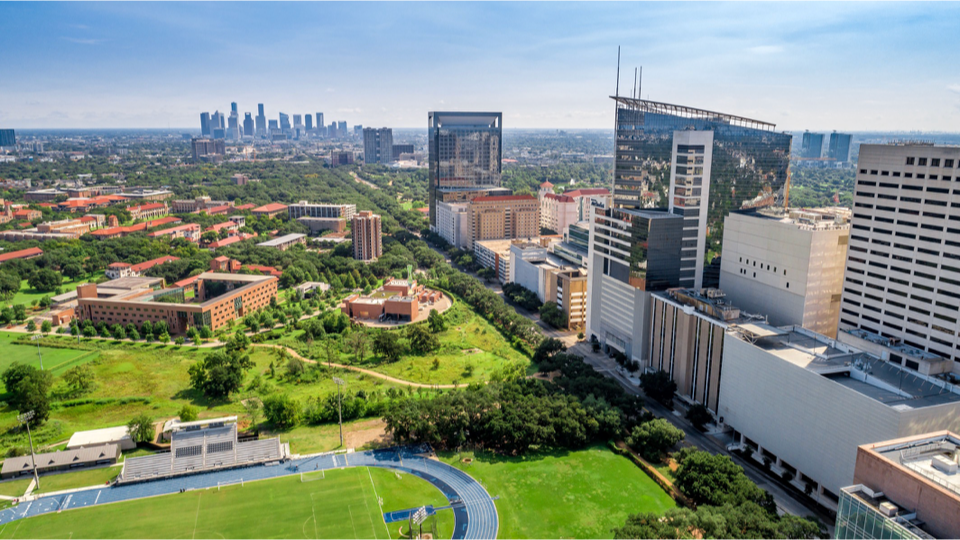
The Texas Medical Center and Rice University in Houston
Of all the mega-Beltways, maybe the most fragile right now is Los Angeles, which is losing not only location shooting but also overall production. It used to be that if you wanted a career in the movies, you had to move to Los Angeles, whereas today it would be a perfectly rational choice to move to Atlanta. (Indeed, Atlanta is probably the best example of a concentrated effort to create a whole new Beltway at the expense of the existing one.) My old joke was that eventually the only part of the entertainment industry left in L.A. would be producers have lunch at The Ivy, a well-known industry restaurant in West Hollywood. But my old WeHo buddies tell me that even The Ivy is a bit empty these days.
The Future Of Where relies on readers like you to become paying subscribers and help keep us in business. Consider a free or paid subscription today!
Nevertheless, as I said on Monday, I think these Beltways will survive, in part because the basic infrastructure in all of these “Beltways” is so strong and powerful that it will be hard to break apart and reassemble somewhere else. They all remain powerful draws to people in those fields, and there’s no question that people who grow up in those places have a head start in those fields.
Indeed, after I posted the Substack piece over on LinkedIn, I got an interesting comment from John Whitmore, the planning director of Gettysburg, Pennsylvania (talk about being the center of something!). All he said was: “Heckscher-Ohlin always wins.”
What he meant by that is that the economic theory of competitive advantage – the Heckscher-Ohlin theory – is pretty solid. If one city or region or country can make goods or services more cheaply or efficiently than a counterpart, then that location will export those items because other locations will buy them. This is the whole basis of the “traded economy”.
But how do to make sure you retain a competitive advantage – and maintain your Beltway, so to speak, in an increasingly footloose world? Here, then, are three keys to keeping your Beltway. There’s nothing especially new about them and they probably require a little tweaking. But they remain a powerful basis for a city’s or region’s economic competitive advantage even in the post-COVID, Zoom-filled world we live in today.