
Is Sprawl Necessary?
Most cities are going to grow both "up" and "out". How can we make the "out" part of that growth as beneficial as possible?

Yesterday, as I was preparing to give a speech in Fort Worth, the estimable Conor Dougherty published an article in The New York Times Magazine essentially endorsing the idea of Texas-style sprawl as part of the solution to the nation’s housing problem.
Focusing on the north Dallas suburb of Celina – the fastest-growing city in the country, about 60 miles away from where I was giving my speech – Dougherty quoted a lot of lefty folks as concluding that housing has become such a huge problem that only sprawl can solve it.
Thanks for reading. The Future Of Where is made possible by our paying subscribers. Please help us continue to deliver good content by becoming a free or paid subscriber.
Not surprisingly, Dougherty was immediately eviscerated by the smart growth crowd for writing an article titled “Why America Should Sprawl”. Beth Osborne, the head of Transportation For America, said on X that Dougherty’s view was “the only way to fix the housing crisis is to build the wrong housing where people don’t want it so that their overall expenses go up, traffic gets worse and quality of life goes down.”
But the thing is, Dougherty is at least partly right.
Fort Worth isn’t Celina, but it is one of the fastest-growing larger cities in the country, having almost doubled in population (to about 1 million) since the turn of the century. It’s doing a lot of things right in redeveloping downtown and building infill projects in downtown-adjacent locations. But it’s also got lots of raw land inside the city limits and in areas likely to be annexed to the city in the future. And so my message last night – in a speech sponsored by Community Design Fort Worth – was that cities like Fort Worth are going to grow both up and out. And so we’d better make sure we do both pretty well.
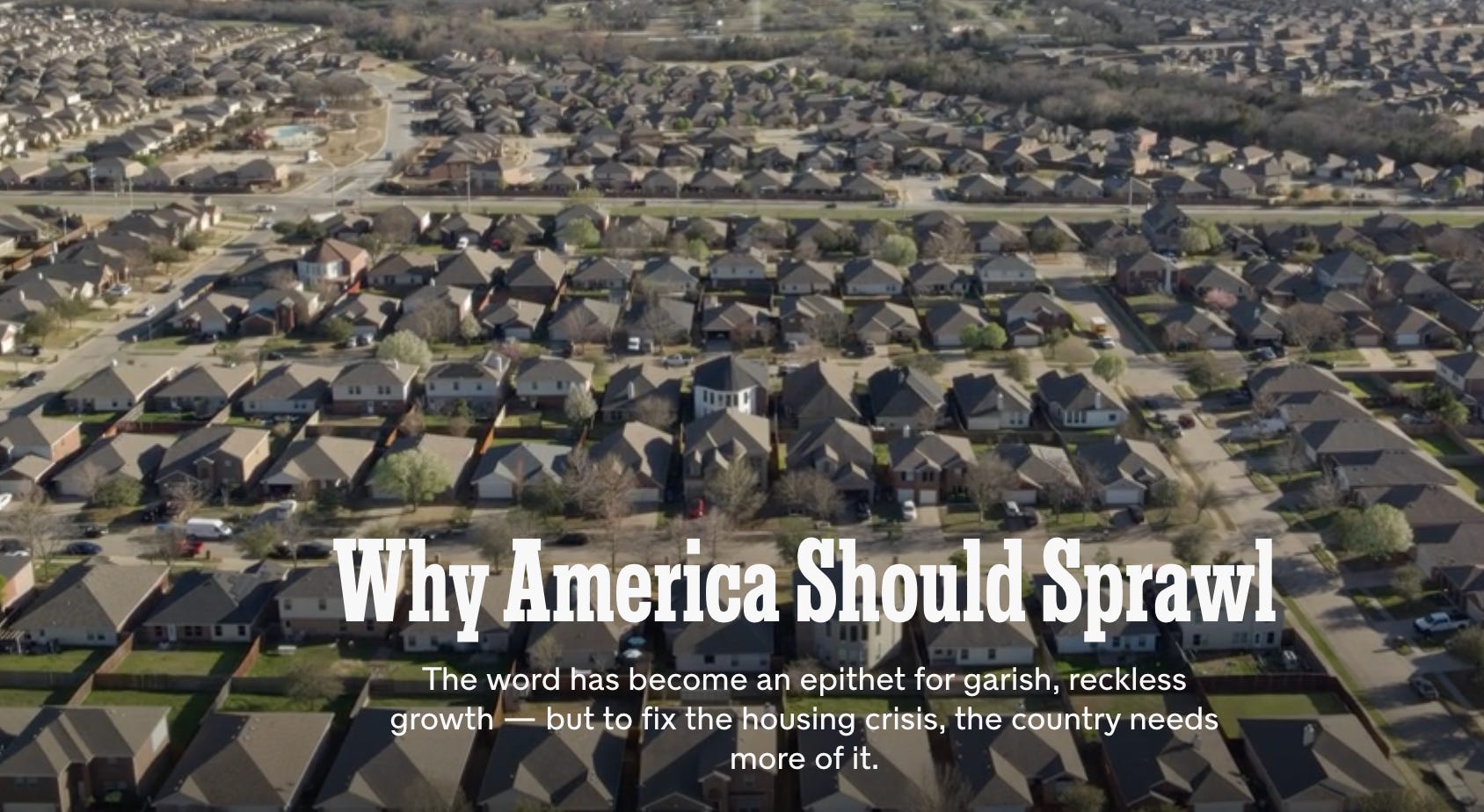
Conor Dougherty’s article in The New York Times.
I came to this conclusion after spending all afternoon tooling around suburban Fort Worth with Ann Zadeh, a former city councilmember and mayoral candidate who now runs Community Design Fort Worth. The pattern was depressingly familiar to anybody who has toured a major American city. Downtown was bustling with an arts festival and some close-in neighborhoods have redeveloped and gentrified. Historically African-American neighborhoods remain neglected and cut off from the rest of the city by freeways and railroads. And as we drove out from the center of the city, we went through generation after generation of postwar suburban development – winding up on the fringe, with its six-lane highways, Chick Fil A’s, drive-through Starbucks, and not-quite-gated subdivisions with pleasant-sounding names.
All pretty standard stuff. You’d find the same thing in Celina – except at an even more massive scale, if that’s imaginable. (The last time I was in Celina, we drove with my wife’s relatives “down the street” to a youth soccer game, and “down the street turned out to be about eight miles one way.)
Given this landscape, it’s not surprising that many people in the smart growth crowd tend to think of all suburban development as bad. Most of it is.
And yet ….
Sprawl is not the same thing as outward urban expansion.
Sprawl, in the classic definition, is low-density, unplanned, discontiguous, auto-oriented development.
Not all new suburban development has to fit that definition, but a lot of people who dislike sprawl paint all outward urban expansion with the sprawl brush. Indeed, last night in Fort Worth after I said some nice things about cities growing outward, I got some pushback from the crowd that I was pro-sprawl. And late last night I got an email from a friend of mine in Oregon who complained that growth management folks in that state paint everything as sprawl. He wished there was a better name.
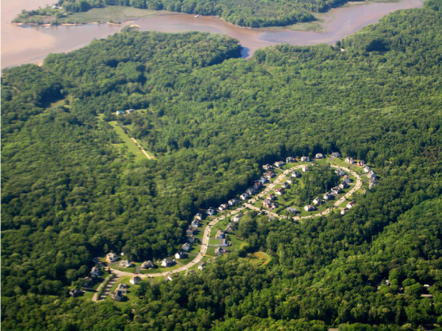
Classic suburban sprawl.
Yet even in California, which like Oregon has been at the forefront of trying to curtail outward urban expansion, there’s been some rethinking. As I mentioned in a Substack post a few months ago, the proposed California Forever new town has highlighted the fact that a lot of new development in California is, in fact, “greenfield” development – sprawl to some people – and maybe the best sources is to make it better.
So, especially in places like Texas, where land is plentiful and regulation is light, we are going to see a lot of outward urban expansion – a lot of out as well as up. With that in mind, here are the four things I told the audience in Fort Worth last night.
