
Our Covenant With Our Communities Is Fraying
The 250th July 4 celebration was a celebration of the miracle America's cities and communities provide for the people who live in them. But can we sustain the way communities help us thrive?

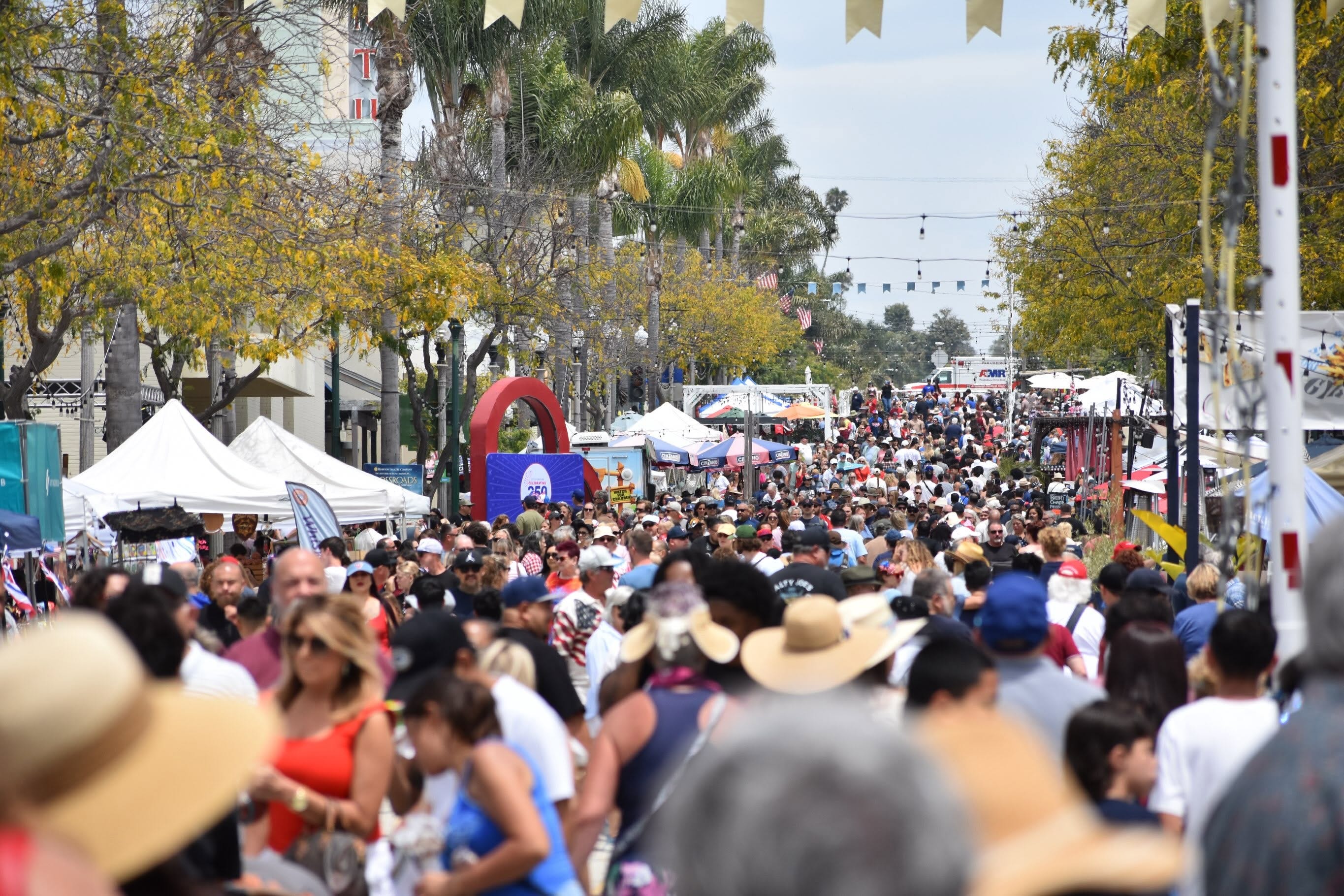
The Fourth of July Street Fair in Ventura (via Ventura Sun)
Become a free or paid subscriber of The Future Of Where today! We depend on your support to continue bringing you great content.
If ever there was a holiday that needs a Main Street, it’s the Fourth of July. It’s a holiday where American communities celebrate themselves as much as they celebrate American Independence, complete with parades, street fairs, and fireworks.
I was lucky enough to grow up in a town in Upstate New York with a Main Street that had a July 4 parade every year, which my parents took me to religiously – and which I dutifully covered, as a young reporter, on America’s 200th anniversary. My adopted hometown of Ventura, California, has a truly American set of celebrations. It begins with the truly (small d) democratic “pushem-pullem parade” (in which anybody with non-motorized wheels can participate) and continues for the rest of the day with a truly great street fair. And Saturday night here in San Diego, as we stood on our balcony, we saw that every single car on Broadway stopped so that the drivers could watch the 20-minute fireworks extravaganza.
Yes, the 250th anniversary of American independence was celebrated with true exuberance in communities all across the country. But setting aside the big-picture political turmoil and sharp divisions that we see across the nation, I have great fear that our communities and places are struggling. Where is not easy to maintain in troubled times.
As I often said when I was in elected office, a successful place is the result of a covenant between a community (meaning the local government and all the institutions that serve that community) and the people who live there. The community is committed to the well-being of the people, and the people, in turn, are committed to contributing to sustaining the community and making it better.
Increasingly, unfortunately, this isn’t what I see, and many of the struggles our communities face are a result of the fact that this covenant is beginning to break down. Many of these struggles are the result of larger societal trends, and it is not always possible for people at the “local place level” to effectively counteract those trends. But there’s no question that the threads are becoming frayed.
The most obvious example is housing, which has become unaffordable almost everywhere in the last decade. The bottom line is not enough of the right type of housing is being built at the right price for the way our society is currently organized. Again, not all of this is a community-level problem – interest rates are higher than they’ve been in a while, construction techniques are outmoded, and so forth. And so local action won’t solve the problem alone. But it is true that we have zoned most of the country for a Norman Rockwell-style ideal of the nuclear family living in single-family houses, and that’s just not our society today. It won’t be – and can’t be – the future of where in the United States, no matter how much we may want to wish this to be true.
The Big Sort
Then there’s the political and cultural sorting of people into different communities. This isn’t so much a problem of one community but of the relationship between communities. And it changes the nature of the covenant.
We have always clustered in some way or another into specific communities and specific neighborhoods. We have always separated ourselves by race, by ethnicity, and by economic class. But we used to do that within our communities or at least within our local cluster of communities (often at the county level). One of the most miraculous things about my time as an elected official in Ventura was the breadth of political and cultural diversity we saw within our city. There were usually a mixture of Democrats and Republicans on the city council, thus reflecting the city as a whole. And one of my most memorable experiences as mayor was to visit a different house of worship every weekend, which helped me to see just how culturally diverse our community was.
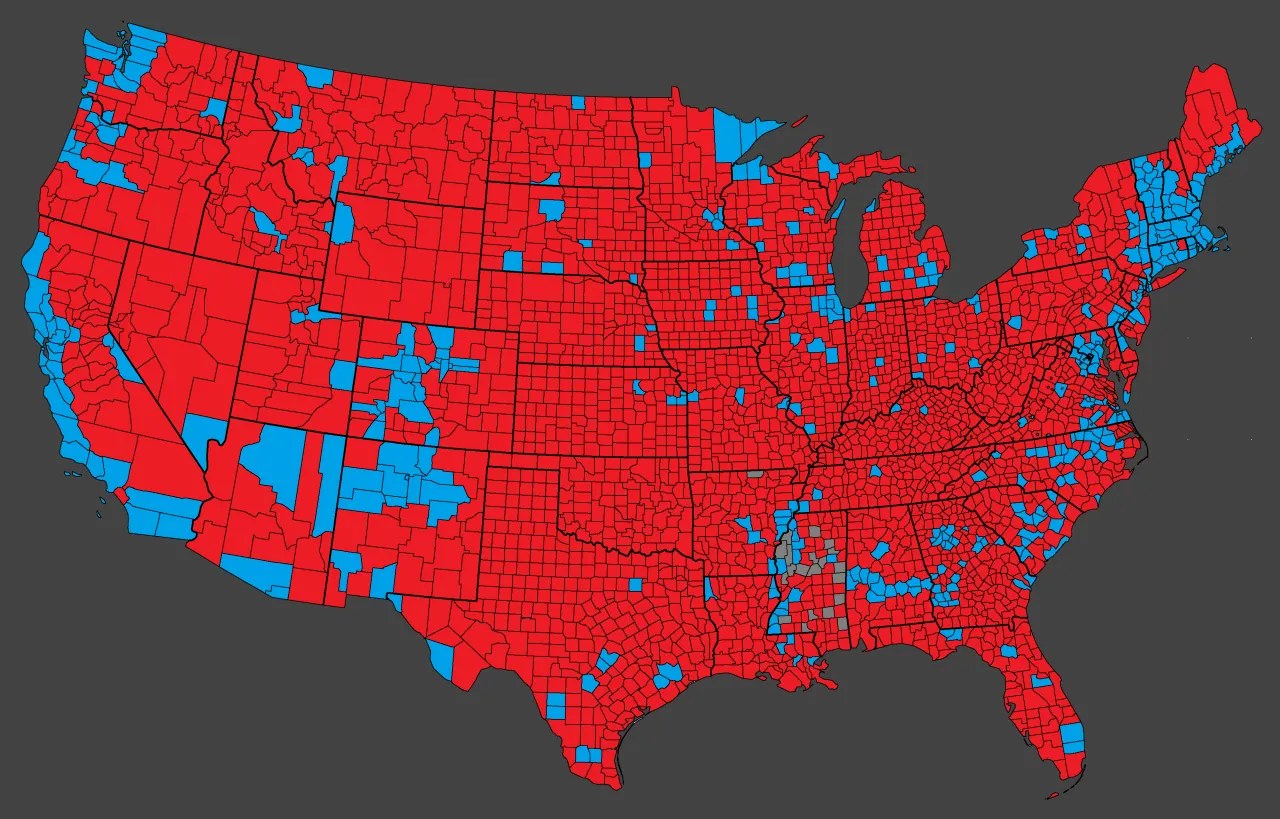
The 2024 county-level election results. Increasingly, we are isolating ourselves politically and culturally.
Increasingly, however, this political and cultural diversity is going away. Even as our society becomes more diverse, cities and communities are becoming more less diverse and more monolithic. And this creates a complicated relationship with the covenant I mentioned above. Because if our communities become more insular and unwelcoming to people unlike ourselves, then the covenant becomes a mechanism for reinforcing this insularity. In theory, the covenant is still working – the community is supporting individuals and vice versa. But people who work in our communities, who serve us – even sometimes our own children – are shut out.
The Strain on the Community Covenant
This strain on the covenant becomes even more evident in zoomtowns and zoomburbs, where a large number of people work remotely for companies that are located somewhere else. On one level, this is a good thing: Instead of commuting long distances, these folks have more time to devote to community life and many of them do exactly that. You might even say that remote work is part of the solution to the Bowling Alone problem of declining civic life.
Yet even as remote workers commit themselves to their local communities, they are accelerating the sorting. If you can work anywhere you can live anywhere, and increasingly people who can live anywhere cluster together. But these folks tend to be of a particular cultural and economic class, and they tend to drive up housing (and other) prices in the zoomtowns and zoomburbs where they settle. People with more modest incomes – especially service workers vital to the local community – get pushed out.
And, of course, remote workers are separated from the economic engines that sustain them. They draw a salary (or, if they are tech workers, they get a bunch of stock), but they are not invested in the community where their business is located and the business they work for is no invested in the community where they live. You can coach soccer, but your employer isn’t going to sponsor the local soccer team.
When I ran a small business in Ventura, I used to joke that my job was to import money into Ventura and then circulate it around town. My company sold its services throughout California and the nation, and with the money I received I employed local folks, bought local services, and donated to local causes all of which helped support my business as we moved forward in selling our services.
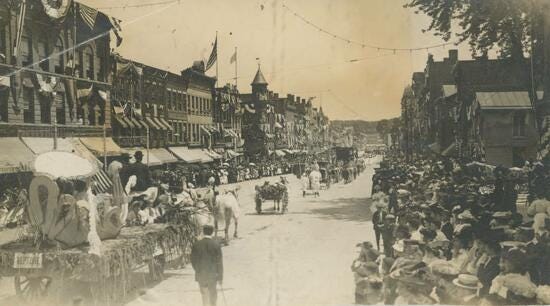
A 1906 parade on Genesee Street in my hometown of Auburn, New York
In that sense, the economic and cultural life of my community could not be separated. The covenant encompassed not just individuals and the municipal government, but everybody in the community and every institution that served the community, including businesses like mine. That’s the essence of a successful place. And I have to admit, as we celebrate the 250th anniversary of our great nation, that’s what worries me the most about the future of where.
“Ask My Anything” Answers Coming Later This Week!
I was astonished at the breadth of questions I got in response to my “Ask Me Anything” pitch. I’ll respond with all the answers later this week!