
Spokane Will Never Be The Same
The last affordable city in the Intermountain West has been trying hard to chart out a positive future. The wildfires will make that goal much harder to accomplish

We rely on our readers to spread the word about The Future Of Where. Help us expand our audience!
The truth is, I was going to write about Spokane today anyway.
I’ve been working in Spokane for the past several months and I’ve come to love it. It’s exactly the kind of city that is thriving these days. It’s a relatively small city, but still an important regional center – the biggest city between Seattle and Minneapolis, as the locals like to say. It’s a picturesque river town with an historic downtown. And it’s been attracting a lot of folks from other places, which has both run up housing prices and brought a lot of new energy to the city.
So there’s a lot of energy in Spokane these days. There’s a Safe and Healthy Spokane Task Force dealing with behavioral health and criminal justice issues, there’s been a lot of zoning and housing reform, and there’s a lot of focus on revitalization of downtown and older cordiros.
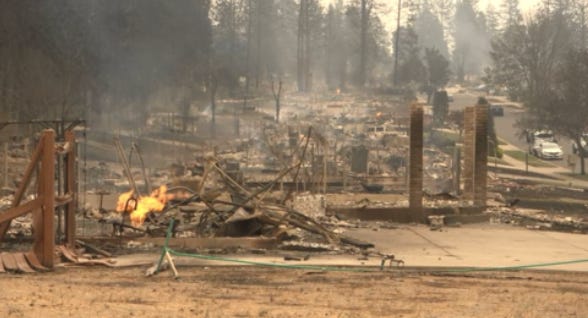
But now all that energy will be redirected for the foreseeable future toward recovering from the devastating wildfires that have destroyed hundreds of structures and forced tens of thousands of people to evacuate – so far. It could get a lot worse before it gets better.
And it forces all of us to come back to a theme I’ve had to deal with over and over again in The Future Of Where: Is anywhere safe? Especially in the bone-dry Western U.S., is anywhere safe from wildfire. And if not, what can you do – to recover from disaster, to mitigate the risk, and the avoid the problem in the first place?
The wildfires in Spoken are still burning and we don’t know how much damage we will eventually see. So it’s premature to predict just how devastated the Spokane community will be.
Spokane Will Never Be The Same
But one thing is for sure: Spokane will never be the same.
When I arrived in Spokane for the first time back in March, I was told over and over again that the place is in a unique position. I was skeptical at first, because as a longtime journalist and consultant, the first thing I am always told when I arrive is that the town is unique, and it’s usually not true. But since then I have come to believe that Spokane, though similar to many other freestanding regional centers in the U.S., is in a unique position – a position that is threatened by the wildfires.
Virtually all cities of any size in the Intermountain West have seen home prices skyrocket since COVID, primarily because of the arrival of “home equity refugees” from the Pacific Coast. Think of Boise, Bozeman, and Bend, for example – all cities of over 100,000 that have been profoundly changed by this trend.
This trend has also been evident in Spokane, where home prices have doubled in the last decade, from around $250,000 to around $500,000. This has become such a concern locally that when Conor Dougherty of The New York Times wrote about the housing market in Spokane, the story was headlined: THE NEXT AFFORDABLE CITY IS ALREADY TOO EXPENSIVE.
Yet to a certain extent Spokane remains undiscovered compared to the other cities I mentioned above. It doesn’t quite have the same cache or the outdoor recreation opportunities. It’s drawn a lot of folks from elsewhere – especially Seattle, not California – but it has not been overwhelmed by newcomers.
And so over and over again what people there have told me is that Spokane is just far enough behind the curve that the city and the region can learn from the experiences of those other places. If enough policies and financial mechanisms can be put in place, and if enough energy is applied to the problem of housing and economic stability, Spokane might be able to escape the fate of spiraling housing prices that has afflicted almost every other city in a desirable natural setting in the Intermountain West.
Can Spokane Not Just Recover But Thrive?
Now, ironically, the wildfire will make that harder. For two reasons: one short-term and one long-term.
First, the short-term problem: As we learned last year from the Los Angeles wildfires in Pacific Palisades and Altadena, recovery for a devastating wildfire requires all of the attention of every civic institution in the community. The housing market will be upended, as people who own homes will suddenly be out there looking for places to rent, competing with people already in the rental market. Philanthropies and nonprofits will have to focus on helping displaced families no matter what other priorities there might be. Banks and credit unions that may have been otherwise focused on helping people into starter homes and startup businesses will have to focus instead on customers who have lost their homes. And on and on. The project I have been working on – helping facilitate more financing for affordable and workforce housing – will likely to have wait until the crisis passes.
But the long-term problem is even tougher to deal with: Weirdly, the end result of a devastating wildfire is almost always that a community goes more upscale than it was before.
Why? Because any community has a lot of residents who are older, have lived there a long time, and often are under-insured. After losing their cherished longtime home and all their belongings, a lot of these folks won’t rebuild. If they’re under-insured, they can’t afford to. And if they’re older, they simply don’t have the heart or the motivation or the time. So they sell their lot and move. And the people who replace them are different.
Maybe the best example of this trend is in Paradise, California, 75 miles north of Sacramento, which burned to the ground in 2018.
Early last year I had a conversation with the mayor of Paradise, which was a modest community before the wildfire, with a median household income of around $65,000. That meant a lot of people couldn’t afford to come back and COVID meant that a lot of equity-rich Bay Area folks started looking at what a good deal Paradise seemed to them. Only a third of the town has been built back and home prices have doubled. Demographically, Paradise is a very different town that it was before the wildfire.
This is likely to happen in some of the neighborhoods in Spokane that are burning. Take, for example, the Indian Trail neighborhood, which burned to the ground over the weekend. Indian Trail’s not in the middle of town by any means; it’s northwest of the city in a largely forested area (which was one of the reasons it burned). And it’s not especially affluent: Before the fire, home prices were running $500,000-$550,000, a little over the median price for Spokane.
In other words, Indian Trail was, by Spokane standards, a fairly affordable suburban neighborhood, which probably also had a lot of longtime homeowners who incomes aren’t really that high. Those folks will probably all leave. Their lots will be purchased by higher-income folks, who will build new, bigger, fancier houses.
Like I say, all these problems will get much worse before the wildfires are brought under control. Sadly, the end result will be that the next affordable city will be even less affordable as a result. Let’s hope Spokane’s civic leaders can bring the same kind of energy to solving the long-term affordability problem that they will undoubtedly bring to the short-term recovery.